Runner's Knee Recovery Time: How Long Does It Really Take?

Runner's knee has a way of showing up at the worst possible moment. You're in the middle of a training block, feeling strong, and then that familiar ache behind the kneecap starts creeping in. So how long is this going to set you back?
As a general guide, runner's knee recovery time is four to six weeks. But every case of runner's knee (patellofemoral pain syndrome) is different. Some runners bounce back in two to three weeks. Others take three months or more, especially if they ignore it early on.
I've worked with hundreds of runners dealing with patellofemoral pain, and the single biggest factor in how quickly they recover isn't the severity of the injury. It's how smart they are about managing it from day one.
If you want a structured plan that takes the guesswork out of your recovery and gets you back running stronger than before, check out Bulletproof Runners. It's my complete programme for runners who are serious about staying injury-free for the long term.
For now, let's work through everything you need to know about runner's knee recovery time, what affects it, and exactly what to do to heal as quickly as possible.
Quick Answer: Runner's knee typically takes 4-6 weeks to recover with proper load management and targeted strengthening. Mild cases can resolve in 2-3 weeks. Severe or long-standing cases may take 3-6 months. Early treatment is the biggest factor in a faster recovery.
What Is Runner's Knee? A Quick Overview
Runner's knee is the common name for patellofemoral pain syndrome (PFPS). It causes pain at the front of the knee, around or behind the kneecap (patella).
The pain usually gets worse when you run, squat, go downstairs, or sit for long periods with your knee bent. Some runners also notice a grinding or clicking sensation under the kneecap.
It's the most common overuse running injury out there. Research shows it affects around 19-30% of female runners and 13-25% of male runners. So if you've got it, you're in very good company.
The key thing to understand is that runner's knee isn't a single, simple problem. It can come from several different causes, including weak glutes, tight quads, poor kneecap tracking, and too much training load too soon. That's exactly why recovery time varies so much from person to person.
Runners Knee Recovery Time: Key Factors That Affect How Long It Takes
Two runners can have the same diagnosis and heal at completely different rates. Here's why.
1. How Severe and Irritable Your Symptoms Are
Severity means how much it hurts. Irritability means how long the pain lingers after you aggravate it.
If your knee hurts a little during a run but settles within an hour, that's a low-irritability presentation. You can usually keep running with some modifications.
If your knee aches for hours after a short walk, that's high irritability. You'll likely need a proper rest period before you can start loading it again.
2. What's Causing It
The underlying cause matters enormously. Common contributors include:
Weak quadriceps or glutes
Tight iliotibial band or hip flexors
Abnormal kneecap tracking
Sudden increases in training volume
Poor running form, particularly overstriding or excessive hip drop
Unsupportive footwear or foot alignment issues
If you address the root cause, you recover faster. If you just rest and do nothing else, the pain often comes back the moment you start running again. I see this pattern constantly with runners who come to me after months of frustration. You can read more about why runner's knee won't go away if that sounds familiar.
3. How Quickly You Act
Early intervention is everything. Runners who catch it early, reduce load, and start a proper rehab programme typically recover in four to six weeks. Runners who push through for months before doing anything about it often face a much longer road back.
4. How Consistent You Are with Rehab
Doing your exercises once a week won't cut it. The runners I see recover fastest are the ones who treat their rehab like training. They show up for it every day, even when it feels boring.
Runner's Knee Recovery Timeline: What to Expect Week by Week
This is a rough guide. Your timeline may differ, but this gives you a realistic picture of what recovery tends to look like.
Week | What's Happening | What to Focus On |
|---|---|---|
Week 1-2 | Pain starts to settle with reduced load | Reduce or stop running, begin gentle strengthening, manage pain |
Week 3-4 | Strength and control begin to improve | Progress rehab exercises, introduce low-impact cardio if pain-free |
Week 5-6 | Daily activities feel normal, knee more stable | Begin return-to-run programme, short easy runs |
Week 6-8+ | Gradual return to full training | Build volume slowly, continue strength work, monitor symptoms |
3+ months | Severe or long-standing cases | Ongoing physio, gait retraining, structured return-to-run plan |
How Long Should You Rest from Running with Runner's Knee?
This is the question I get asked most often, and the honest answer is: it depends.
Some runners need a complete break from running for four to six weeks. Others just need to cut their volume back by 30-50% while they work on their strength and movement quality. Your physio will give you the most accurate answer for your specific situation.
The key variable is irritability. If your pain is both severe and highly irritable, a four to six week reduction in running load is usually the minimum needed before you can start building back up.
If your pain is mild and settles quickly after runs, you may not need to stop at all. You might just need to reduce the duration of your runs and avoid hills and stairs for a few weeks while you work on your strength.
One approach I often recommend is shortening your individual runs but keeping your run frequency the same. So instead of three long runs per week, you do five shorter ones. This keeps your weekly mileage closer to normal while reducing the load on the knee per session.
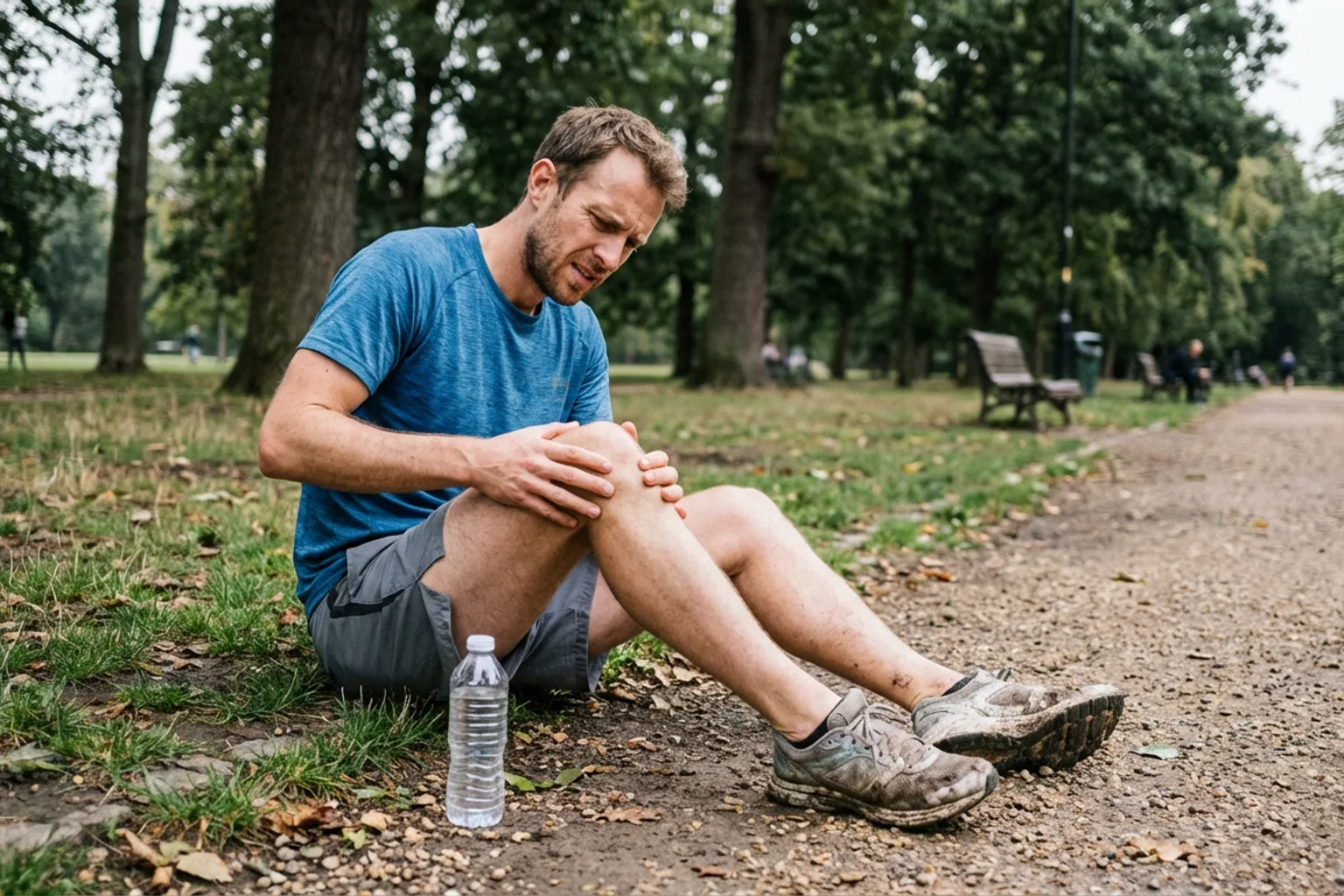
Does Runner's Knee Go Away on Its Own?
This is something a lot of runners hope for. The short answer is: not usually, no.
Rest alone can calm the symptoms down. But if you haven't addressed the underlying cause, the pain tends to come straight back when you start running again. I've seen runners rest for three months, feel great, go out for their first run back, and have the pain return within ten minutes.
The problem is that rest makes you weaker, not stronger. Your knee needs load to recover properly. The goal isn't to avoid loading the knee, it's to find the right level of load and build from there.
Active recovery, doing the right exercises and gradually rebuilding your tolerance for running, is almost always more effective than pure rest. That's the foundation of good patellofemoral pain management.
Can You Walk with Runner's Knee?
Yes, in most cases you can walk normally with runner's knee. Walking puts significantly less load on the kneecap than running does.
That said, some runners with very irritable symptoms find that even walking aggravates their pain, especially on hills or stairs. If that's you, it's a sign your knee needs a proper rest period before you start any kind of loading.
Going downstairs tends to be more provocative than going upstairs, because of the increased force through the kneecap in that position. If stairs are painful, take them one at a time or lead with your unaffected leg going down.
Will Runner's Knee Get Worse if You Keep Running?
Here's something worth understanding. Your pain may increase in response to running in the short term, but that doesn't automatically mean your knee is getting structurally worse.
Remember that cartilage change is often unrelated to pain levels. And cartilage change from activity takes months and years, not days or weeks. So if you have a race coming up and your symptoms are manageable, running it isn't necessarily going to cause lasting damage.
That said, repeatedly ignoring significant pain and pushing through without any management strategy is a different story. That's how a four-week problem becomes a six-month one. Use pain as information, not as something to simply override.
A good rule of thumb: if your pain stays below a 3 out of 10 during a run and settles back to baseline within an hour of finishing, you're probably okay to continue with modifications. If it's spiking above 5 out of 10 or lingering for hours afterwards, back off.
What to Avoid During Runner's Knee Recovery
Just as important as knowing what to do is knowing what not to do. These are the most common mistakes I see runners make:
Doing nothing and waiting for it to disappear. As I mentioned above, passive rest rarely fixes the root cause.
Jumping straight back into full training the moment pain settles. This is how relapses happen.
Ignoring strength work. Stretching alone won't fix runner's knee. You need to build strength, particularly in the quads and glutes.
Running through high pain levels. Pain above 4-5 out of 10 is a signal to back off.
Ramping mileage up too quickly on your return. The 10% rule exists for a reason.
Skipping downhill running modifications. Downhill running dramatically increases patellofemoral load. Avoid it until you're well into recovery.
What You Can Do to Speed Up Runner's Knee Recovery
There are two things I prioritise above everything else when helping a runner recover from patellofemoral pain.
1. Reduce Load on the Injured Knee
Training management is essential. You need to get your pain under control before you can start building back up. That means reducing your running volume, avoiding hills and stairs, and possibly taking a short break from running altogether.
Read my full guide on how to cure runner's knee for more detail on load management and the training errors to avoid.
2. Build Strength Around the Knee
Strengthening the muscles that support your knee is the single most effective thing you can do to speed up your recovery. The key muscle groups are:
Quadriceps: Especially the VMO (the teardrop-shaped muscle on the inside of your knee). Exercises like wall sits, step-downs, and terminal knee extensions all target this area.
Glutes: Weak glutes are one of the most common contributors to runner's knee. Glute exercises like bridges, clamshells, and single-leg deadlifts are essential.
Hamstrings: Often neglected in runner's knee rehab, but important for overall knee stability.
Adductors: These help control how your knee tracks during the stance phase of running.
Here's a simple rehab routine to get you started:
For a more complete set of exercises, see my dedicated 10-minute runner's knee rehab routine.
3. Manage Your Pain
If you need pain relief, get it. This doesn't have to mean medication.
Kneecap taping techniques can be very effective at reducing pain during activity and allowing you to do your rehab exercises more comfortably. Foot orthoses (shoe inserts) also help some runners, particularly those with foot alignment issues. If you're considering insoles, I'd recommend seeing a podiatrist rather than just grabbing something off the shelf. You can read more about whether orthotics work for runner's knee here.
Short-term use of anti-inflammatory medication (like ibuprofen) can help manage acute symptoms, but I wouldn't rely on it long-term. It masks the signal without fixing the problem.
4. Try Low-Impact Cross-Training
If you need to maintain your fitness while your knee recovers, low-impact alternatives can be a lifesaver. Good options include:
Swimming
Cycling (with the seat high enough to avoid deep knee flexion)
Aqua jogging (genuinely brilliant for maintaining running fitness)
Elliptical trainer, if pain-free
Avoid any activity that provokes your knee pain. Squatting, lunging deeply, and stair climbing all put significant load through the kneecap and can slow your recovery if done too aggressively.
5. Address Your Running Technique
For many runners, a change in running form can make a significant difference. Increasing your step rate (cadence) by around 5-10% reduces the load on the kneecap with every stride, and it's one of the most evidence-backed interventions for patellofemoral pain.
Other useful technique changes include reducing overstriding, improving hip stability, and addressing any crossover gait pattern. You can learn more about gait retraining for runner's knee in my dedicated guide.
It's also worth checking whether stronger glutes could reduce your runner's knee risk long-term.
When Does Runner's Knee Require Surgery?
Rarely. The vast majority of runners with patellofemoral pain make a full recovery without surgery.
Surgery should always be the last resort, after all conservative options have been exhausted. The evidence is clear: surgical procedures for typical kneecap pain don't outperform conservative care in clinical trials. Good knee surgeons know this, and most will refer you to a physiotherapist rather than reaching for the scalpel.
There are a few exceptions. If your knee is locking, giving way, or you have a loose body or unstable cartilage defect, surgery may be the right call. But these situations are genuinely rare. If you're experiencing those symptoms, see a sports medicine doctor or orthopaedic specialist for a proper assessment.
How to Return to Running After Runner's Knee
This is where a lot of runners undo all their good work. They feel better, get excited, and go straight back to the same training volume that caused the problem in the first place.
Here's a smarter approach:
Start with short, flat runs. Your first run back should be no more than 10-15 minutes on a flat surface. Avoid hills entirely to begin with.
Use the run-walk method. Alternate one minute of running with one minute of walking. Gradually shift the ratio over two to three weeks.
Monitor your pain response. Keep pain below 3 out of 10 during runs. If it settles within an hour of finishing, you're progressing well.
Increase volume before intensity. Get your easy mileage back first. Don't add speedwork or hills until you've been running comfortably for at least two to three weeks.
Keep doing your strength work. Don't stop your rehab exercises the moment you start running again. This is a long-term commitment, not a temporary fix.
For a full guide on coming back safely, read my article on how to return to running after injury.
When Should You See a Physiotherapist?
Honestly? Sooner than most runners do.
If your pain has been present for more than two weeks, isn't improving with rest and basic self-management, or keeps coming back every time you try to run, it's time to get a proper assessment. A good physio will identify the specific cause of your runner's knee, not just give you generic exercises.
Don't wait until you've been struggling for three months. Early intervention consistently leads to faster recovery. That's not just my opinion, the research backs it up.
If you're also dealing with other niggles alongside your knee pain, my guide to preventing recurring running injuries is worth a read.
Frequently Asked Questions About Runner's Knee Recovery
How long does runner's knee last without treatment?
Without treatment, runner's knee can persist for months or even years. Rest alone rarely fixes the underlying cause. Most runners who don't address the root problem, such as muscle weakness or poor running form, find that symptoms return as soon as they resume training. Active rehabilitation is almost always faster than waiting it out.
Can I run with runner's knee?
It depends on your pain level and irritability. If pain stays below 3 out of 10 during running and settles within an hour afterwards, you can usually continue with reduced volume. If pain spikes above 5 out of 10 or lingers for hours, you need to reduce load significantly or take a break from running.
Is runner's knee serious?
Runner's knee is not considered a serious condition in most cases. It rarely causes permanent damage and almost never requires surgery. However, if left untreated for a long time, it can lead to cartilage changes and become harder to manage. Early treatment gives you the best chance of a quick, full recovery.
What is the fastest way to recover from runner's knee?
The fastest recovery comes from combining three things: reducing training load to calm symptoms, doing targeted strengthening exercises for the quads and glutes, and addressing any contributing factors like running form or footwear. Consistency with rehab matters more than any single treatment.
Can runner's knee come back after recovery?
Yes, it can, especially if you return to the same training habits that caused it in the first place. The good news is that runners who address the underlying weaknesses and make lasting changes to their training and technique significantly reduce their risk of recurrence. Ongoing strength training is your best prevention strategy.
The Bottom Line on Runner's Knee Recovery Time
Most runners recover from runner's knee in four to six weeks with the right approach. Some recover faster. Some take longer. The difference almost always comes down to how early you act, how consistent you are with your rehab, and whether you actually address the root cause rather than just resting and hoping for the best.
The good news is that runner's knee is very preventable once you understand what's driving it. Build your strength, manage your training load sensibly, and pay attention to your running form. Do those things consistently and you'll spend a lot less time on the injured list.
If you want a structured, coach-led programme that covers all of this and more, I'd love for you to check out Bulletproof Runners. It's built specifically for runners who want to train consistently, stay injury-free, and actually get faster over the long term. Everything from strength and rehab to training structure and technique is covered in one place. It's the programme I wish existed when I first started coaching.