Running Injuries Over 40: How to Prevent and Recover Smarter
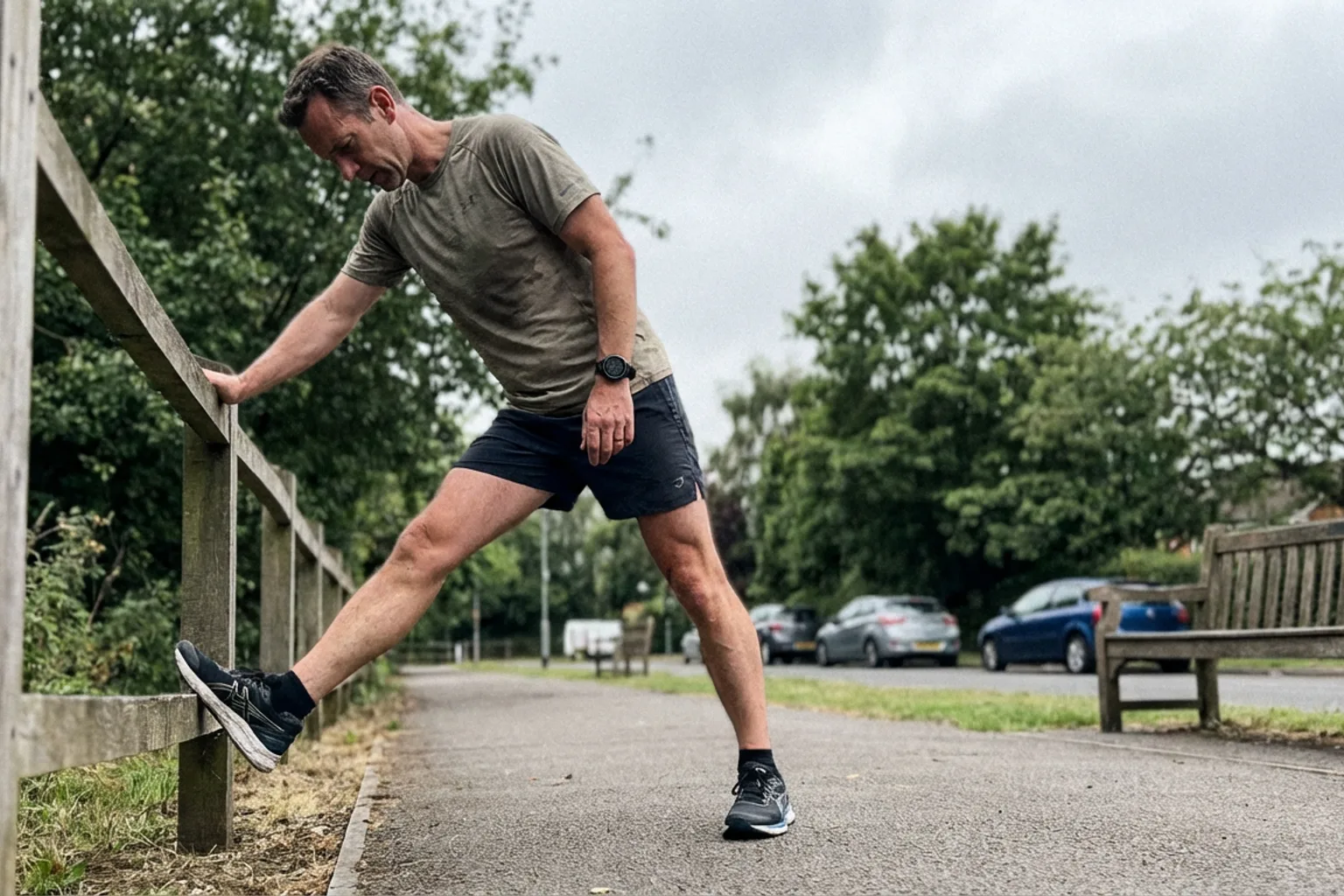
If you're dealing with running injuries over 40, I want you to know something straight away: your body hasn't betrayed you. It's just changed. And the training approach that worked brilliantly in your 30s may now be working against you.
I've coached hundreds of masters runners over the past two decades. The ones who stay healthy and keep improving aren't the ones with the best genetics. They're the ones who understand what's actually changed in their bodies and adapt their approach accordingly.
This guide gives you a clear, step-by-step system to prevent the most common running injuries after 40, manage them when they do show up, and come back stronger than before.
Quick answer: Running injuries over 40 most often affect the Achilles tendon, knees, plantar fascia, and hamstrings. The root causes are declining connective tissue elasticity, muscle loss, slower recovery, and hormonal shifts. The fix is a structured combination of smarter training load management, targeted strength work, improved movement quality, and better recovery habits.
Why Running Injuries Over 40 Are Different
Here's something most running articles won't tell you: the injuries you're getting in your 40s and 50s are not the same injuries you got in your 20s and 30s.
Research by McKean et al. found that masters runners suffer significantly more soft-tissue injuries, particularly in the calf, Achilles, and hamstrings, compared to younger runners. Younger runners tend to get bone stress injuries and overuse knee pain. You're more likely to be dealing with tendon and muscle issues.
Why? Three main reasons.
Your Connective Tissue Has Changed
After 40, your tendons and ligaments lose elasticity. They become stiffer and less able to absorb and return energy efficiently. This is why Achilles tendon injuries are so common in masters runners. The tendon simply can't handle the same repetitive loading it once could without adequate recovery time.
You're Losing Muscle Mass
From your 30s onwards, you lose roughly 3-8% of muscle mass per decade. This process accelerates after 40. Less muscle means less joint support, less shock absorption, and weaker propulsion. Your joints pick up the slack. That's when things start to hurt.
Recovery Takes Longer
Your body produces less growth hormone and testosterone after 40. Both are critical for tissue repair. What once took 24 hours to recover from now takes 48-72 hours. Ignore this and you'll keep training on tissue that hasn't fully repaired. That's how acute soreness becomes a chronic injury.
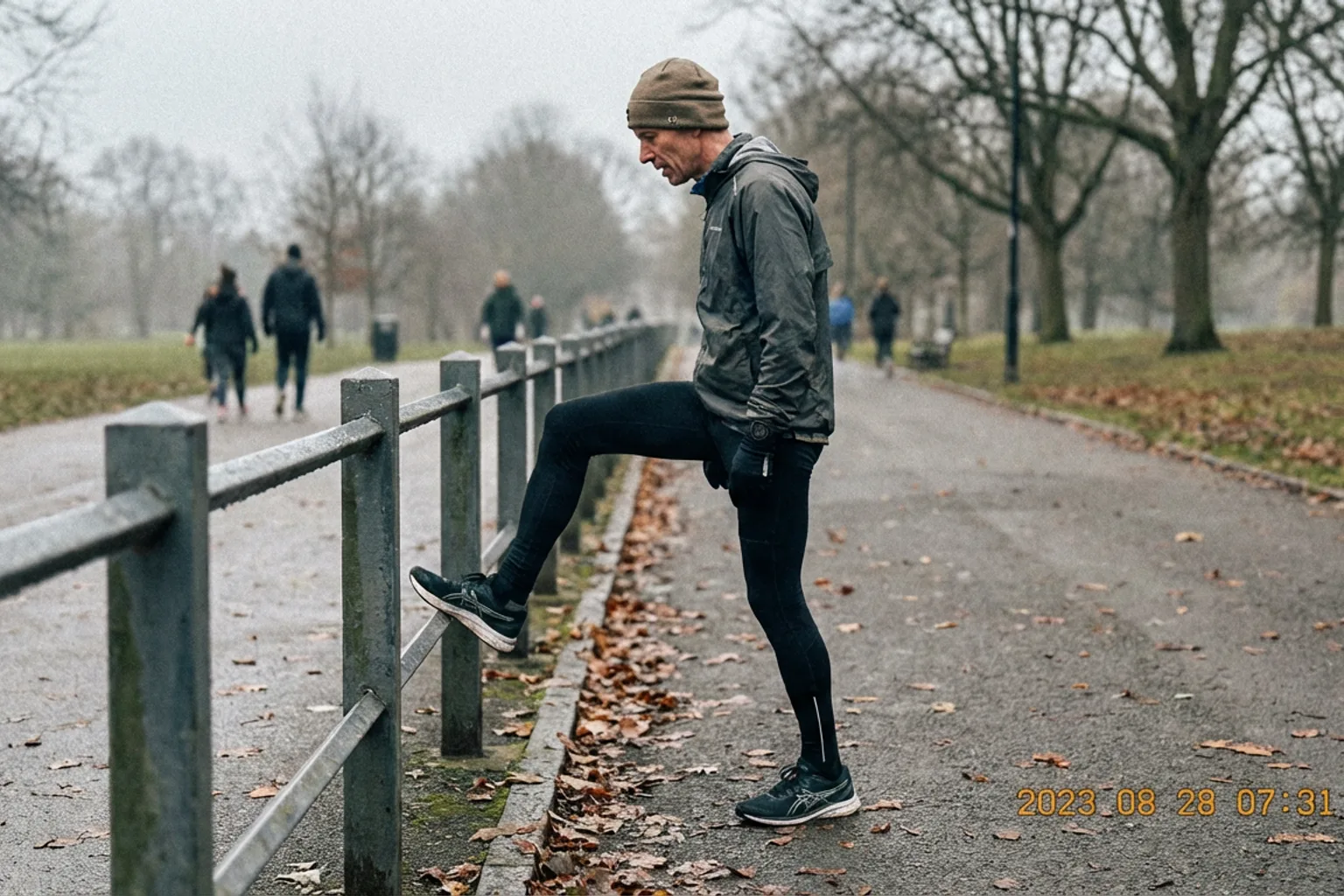
Step 1: Identify Your Injury Pattern
Before you can fix anything, you need to know exactly what you're dealing with. Here are the most common running injuries after 40, what they feel like, and where they show up.
Achilles Tendinopathy
This is the number one injury I see in masters runners. You'll feel stiffness and pain at the back of your lower leg, usually worst first thing in the morning or at the start of a run. It often eases as you warm up, which is why so many runners ignore it until it becomes serious.
Don't ignore morning stiffness in your Achilles. It's a warning sign, not just "getting older."
Read more about Achilles tendon warning signs so you know when to act fast.
Runner's Knee (Patellofemoral Pain)
A dull ache around or behind the kneecap. Gets worse going downstairs, squatting, or sitting for long periods. Often caused by weak glutes and hip muscles that can't control the knee properly during the stance phase of running.
Check out the full guide on running gait re-education for patellofemoral pain for the evidence-based approach I use with my athletes.
Plantar Fasciitis
Sharp heel pain, especially with your first steps in the morning. The plantar fascia is a thick band of connective tissue running along the sole of your foot. After 40, reduced tissue elasticity makes it more vulnerable to overload. Tight calves are almost always part of the problem.
IT Band Syndrome
Pain on the outside of the knee, usually appearing after a consistent distance into a run. Often linked to hip weakness and a crossover gait pattern that increases lateral stress on the knee.
Hamstring Tendinopathy
Deep ache or pain at the top of the hamstring, right where it attaches to your sitting bone. Worse when sitting on hard surfaces or running hills. This one is increasingly common in masters runners and notoriously slow to heal if you don't address it correctly.
Calf Strains and Tears
Sudden sharp pain in the calf mid-run, often described as feeling like someone kicked you. The medial gastrocnemius is the most commonly affected muscle. After 40, reduced muscle elasticity makes this injury much more likely, especially when you're fatigued or under-recovered.
If you've had calf issues, read this guide on treating calf pain after running before your next session.
Shin Splints
Pain along the inner edge of the shinbone. More common when ramping up mileage too quickly. While often seen as a "beginner" injury, masters runners who return after a break are very susceptible. Learn more in this overview of shin splints and common running injuries.
Stress Fractures
Localised bone pain that worsens progressively during a run and doesn't ease with warm-up. After 40, particularly in women approaching menopause, reduced bone density increases the risk. If you suspect a stress fracture, stop running and get it assessed. Don't push through this one.
For foot-specific stress fractures, this guide on metatarsal stress fracture rehab is worth reading.
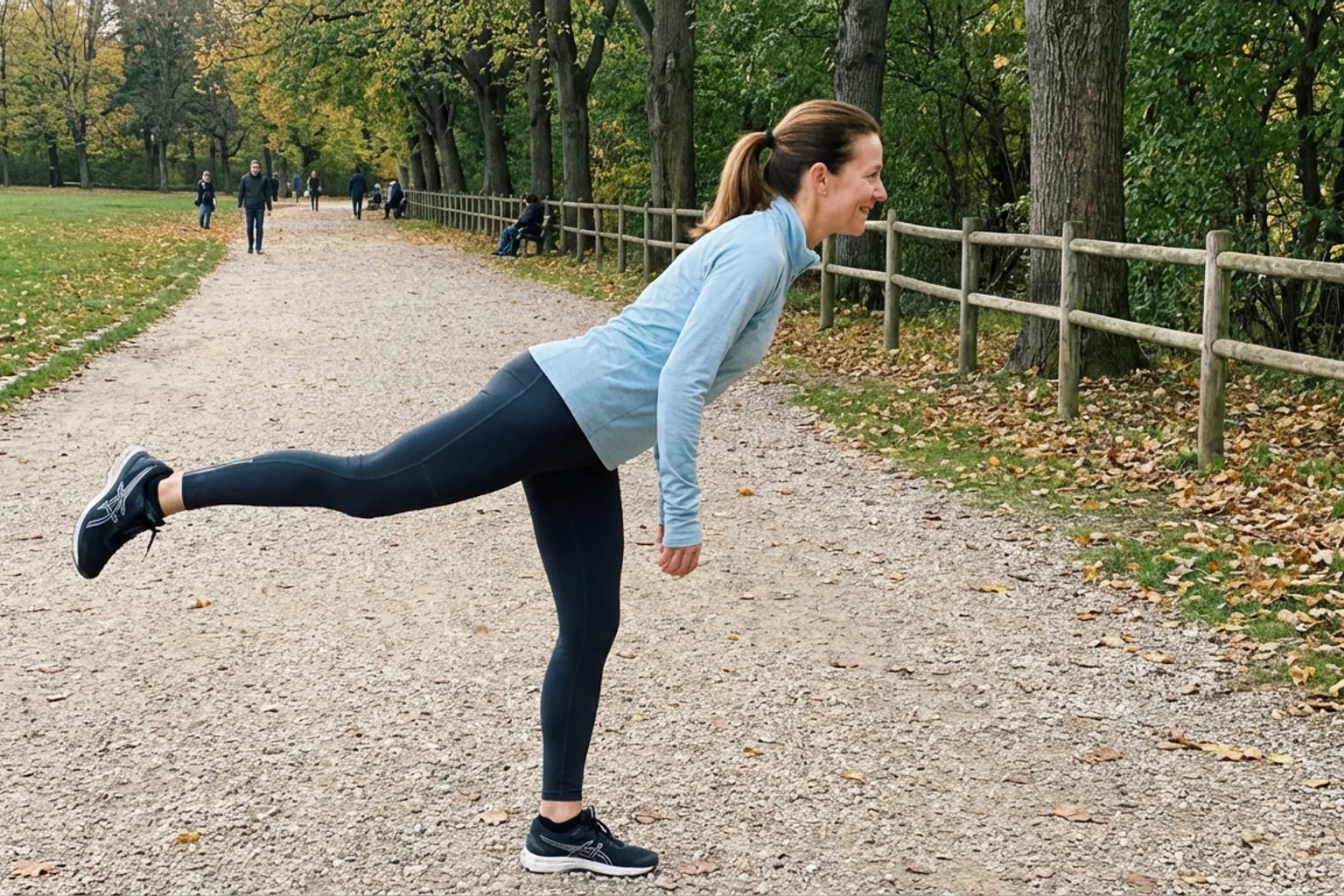
Step 2: Audit Your Training Load
Most running injuries over 40 aren't caused by a single bad session. They're caused by accumulated load that exceeds your body's ability to recover.
Here's how to audit your training load right now.
The 10% Rule (With a Caveat)
You've probably heard: never increase your weekly mileage by more than 10% per week. This is solid general advice. But after 40, I'd actually recommend a more conservative approach: increase mileage by no more than 10% every two weeks, not every week.
Your tendons and connective tissue adapt more slowly than your cardiovascular system. You might feel fit enough to run more, but your Achilles or plantar fascia isn't ready yet. That mismatch is where injuries happen.
The 80/20 Intensity Split
Research consistently shows that elite endurance athletes spend around 80% of their training time at low intensity and only 20% at moderate to high intensity. Most recreational runners over 40 do the opposite. They run most of their miles at a "comfortably hard" pace that's too fast to be truly easy, but not hard enough to deliver real fitness gains.
This grey zone is where masters runners get hurt. You're accumulating fatigue without adequate recovery.
How to calculate your easy pace:
- Use the talk test: you should be able to hold a full conversation without gasping
- Use heart rate: keep easy runs at 65-75% of your maximum heart rate
- Use perceived effort: a 4-5 out of 10, where 10 is an all-out sprint
If your easy runs feel genuinely easy, you're probably doing it right. Most runners I work with are shocked at how slow their easy pace actually needs to be.
Sample Weekly Training Structure for Masters Runners
| Day | Session | Intensity | Duration |
|---|---|---|---|
| Monday | Rest or mobility work | Very low | 20-30 min |
| Tuesday | Easy run | Low (65-70% max HR) | 30-45 min |
| Wednesday | Strength training | Moderate | 30-40 min |
| Thursday | Easy run with strides | Low + 4x20s strides | 35-45 min |
| Friday | Rest or cross-training | Low | 30 min |
| Saturday | Quality session (tempo or intervals) | High (80-90% max HR) | 40-50 min |
| Sunday | Long easy run | Low (65-70% max HR) | 60-90 min |
Notice there's one real rest day, one strength session, and only one high-intensity running session. That's intentional. After 40, recovery is training.
Step 3: Build a Strength Training Foundation
This is the single most important change you can make to reduce running injuries over 40.
Research shows that strength training reduces running injury risk by up to 66%. That's a staggering number. And yet most masters runners treat it as optional. It isn't. Not any more.
Here's the thing: you don't need to spend hours in the gym. Two 30-minute sessions per week will make a significant difference.
Phase 1: Foundation Strength (Weeks 1-4)
If you're new to strength training, start here. Focus on bodyweight movements and basic loading patterns.
Exercise 1: Single-Leg calf raises
- Stand on one foot on a step, heel hanging off the edge
- Lower your heel slowly over 3 seconds
- Rise up over 1 second
- Do 3 sets of 15 reps each side
- Progress by adding a light dumbbell in the opposite hand
This is the most important exercise for Achilles tendon health. Don't skip it. Here's a useful calf strength drill to complement your calf raises.
Exercise 2: Single-Leg Glute Bridge
- Lie on your back, one knee bent, other leg straight
- Drive through your heel to lift your hips
- Hold for 2 seconds at the top
- 3 sets of 12 reps each side
Weak glutes are behind a huge proportion of the knee and hip injuries I see. Read the full guide on how to engage your glutes when running to understand why this matters so much.
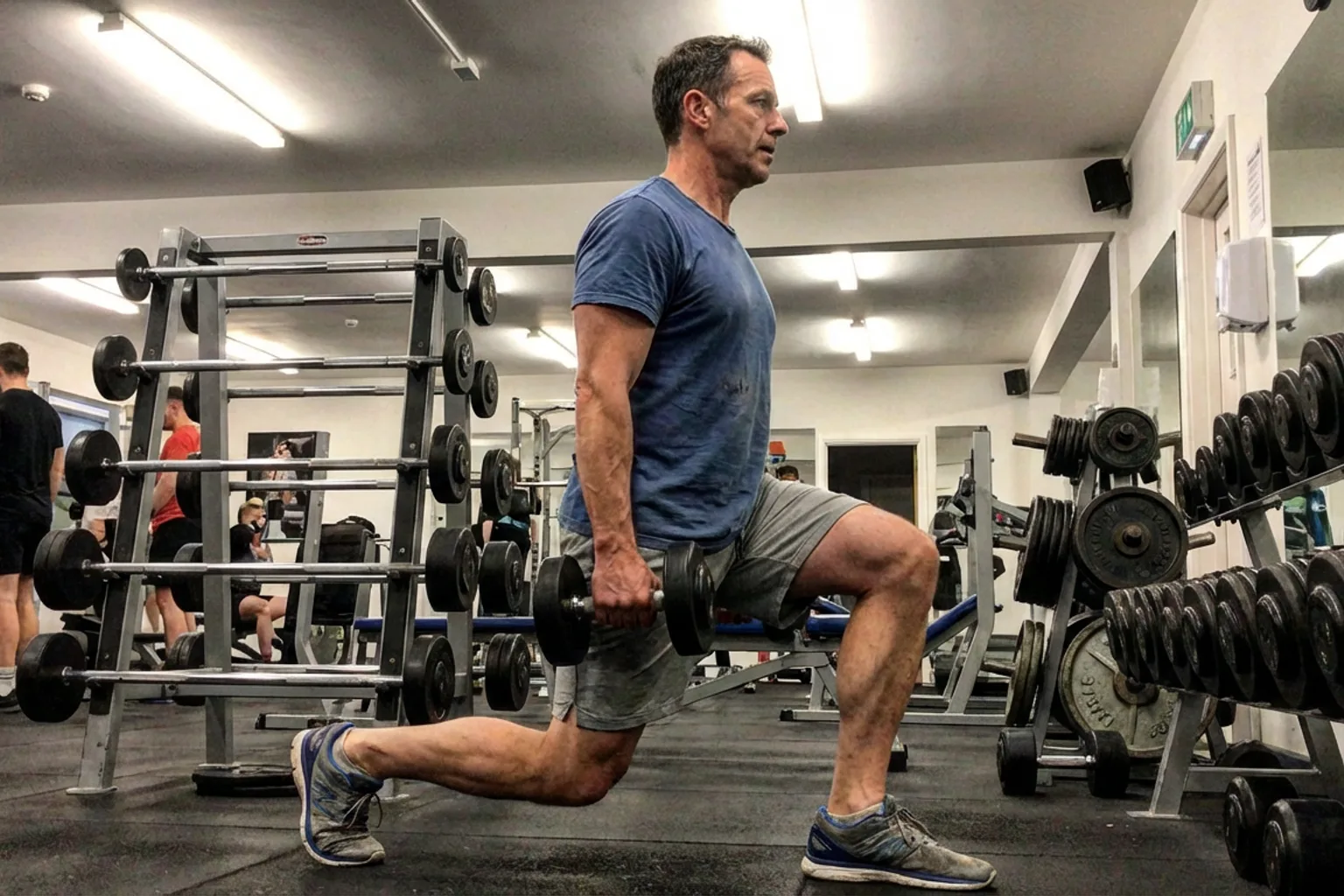
Exercise 3: Reverse Lunge
- Step backwards into a lunge, keeping your front knee over your ankle
- Lower until your back knee nearly touches the floor
- Drive back to standing through your front heel
- 3 sets of 10 reps each side
Exercise 4: Hip Hinge (Romanian Deadlift)
- Stand with feet hip-width apart, holding light dumbbells
- Hinge forward from your hips, keeping your back flat
- Lower weights to mid-shin level
- Drive hips forward to stand
- 3 sets of 10 reps
Exercise 5: Side-Lying Hip Abduction
- Lie on your side, top leg straight
- Lift top leg to 45 degrees, keeping toes pointing forward
- Lower slowly
- 3 sets of 15 reps each side
Phase 2: Load Progression (Weeks 5-10)
Once you've built a base, increase the challenge. Add external load, increase range of motion, and introduce more single-leg work.
- Replace reverse lunges with bulgarian split squats (rear foot elevated)
- Add a barbell or heavier dumbbells to your Romanian deadlift
- Progress calf raises to full range on a step with a 4-second eccentric
- Add a resistance band to hip abduction exercises
- Introduce single-leg Romanian deadlifts for hip stability
For a more detailed approach to strength work, this guide on TRX training for runners gives you excellent bodyweight loading options you can do anywhere.
Phase 3: Maintenance (Ongoing)
Once you've built a solid strength base, you can maintain it with two sessions per week. Don't drop below this. Strength gains from masters runners decay faster than in younger athletes if you stop training.
Step 4: Fix Your Running Form
Poor running mechanics become much more costly after 40. Compensations that your body could absorb in your 30s now lead to injury because your tissues have less tolerance for abnormal loading.
Here are the most common form faults I see in masters runners and how to fix them.
Over-Striding
Landing with your foot well ahead of your centre of mass creates a braking force with every step. It increases load on your knee, hip, and lower back. After 40, this is a major contributor to knee and hip injuries.
The fix: increase your cadence by 5-10%. Aim for around 170-180 steps per minute. Use a metronome app to train this. Read more about what over-striding actually is and how to correct it.
You can also use a metronome to improve your running cadence systematically.
Crossover Gait
This is where your feet land across your midline rather than in two parallel tracks. It increases lateral forces on your knees and IT band. It's one of the most common gait faults I see in runners with IT band syndrome and runner's knee.
The fix: widen your step width slightly. Imagine running along two parallel railway tracks. Strengthen your hip abductors. Read the full guide on correcting crossover running gait.
Hip Drop
If your pelvis drops to one side as you run, you're loading one hip, knee, and IT band asymmetrically. This is almost always a sign of weak glute medius muscles. Read about hip drop running gait causes and fixes for the full picture.
Forward Head Posture
Slouching forward and letting your head drop shifts your entire centre of mass forward. It loads your lower back and changes your breathing mechanics. Head position affects your entire running posture more than most runners realise.
The fix: run tall. Imagine a string pulling the crown of your head upward. Keep your gaze on the horizon, not the ground five metres ahead of you.
Step 5: Prioritise Warm-Up and Cool-Down
I know. You're busy. You just want to get out and run. But skipping your warm-up after 40 is one of the fastest ways to end up injured.
After 40, your tissues need more time to prepare for load. Cold tendons and muscles are less elastic and more prone to micro-tears. A proper warm-up isn't just nice to have. It's injury prevention.
Your Pre-Run Warm-Up (10 Minutes)
Use this five-minute running warm-up routine as your starting point, then extend it slightly with these additions:
- Brisk walk or easy jog: 3-5 minutes. Get blood moving to your muscles before you ask them to work hard.
- Leg swings: 10 each direction per leg. Forward-back and side-to-side. Opens up your hips dynamically.
- Hip circles: 10 each direction per leg. Mobilises the hip joint through its full range.
- Walking lunges with a twist: 10 reps. Activates glutes and opens up hip flexors.
- High knees: 20 metres. Activates hip flexors and gets your knees driving forward.
- Glute activation: 10 clamshells or banded walks. Wakes up the glutes before they're needed.
Check out the full running warm-up structure guide for more detail on how to build this into your routine.
Your Post-Run Cool-Down (10 Minutes)
End every run with 5 minutes of easy walking followed by static stretching. Focus on:
- Calf and Achilles: hold 30-45 seconds each side
- Hip flexors: kneeling lunge stretch, 30-45 seconds each side
- Hamstrings: seated or standing, 30-45 seconds each side
- Glutes: figure-four stretch, 30-45 seconds each side
- IT band and TFL: cross-leg standing stretch or foam roller
Here's a full post-run stretching tutorial with video guidance if you want to see the technique.
Step 6: Manage Recovery Like a Professional
Recovery is where adaptation happens. After 40, you need to take this seriously.
Sleep: Your Most Powerful Recovery Tool
Aim for 7-9 hours per night. I know that sounds obvious. But research shows that sleeping fewer than 6 hours per night increases injury risk significantly. Growth hormone, which drives tissue repair, is released primarily during deep sleep. Cut your sleep short and you cut your recovery short.
Practical tips to improve sleep quality:
- Keep a consistent sleep and wake time, even at weekends
- Avoid screens for 60 minutes before bed
- Keep your bedroom cool (around 18 degrees Celsius is optimal)
- Avoid alcohol in the evening: it fragments sleep quality even if it helps you fall asleep
Nutrition for Recovery After 40
Aim for 1.2-1.6 grams of protein per kilogram of bodyweight daily. For a 75kg runner, that's 90-120g of protein per day. Spread it across meals rather than loading it all into one sitting.
Eat within 30-45 minutes of finishing a hard session. This window matters more after 40 because your anabolic response to exercise is blunted compared to younger athletes. A combination of protein and carbohydrate works best.
Active Recovery Sessions
On your rest days, don't just sit still. Low-intensity movement promotes blood flow and speeds up tissue repair without adding training stress.
Options that work well:
- Easy swimming or pool walking
- Aqua jogging: excellent for maintaining fitness while injured
- Gentle cycling
- Yoga or mobility work
If you're injured and need to maintain fitness, read this guide on aqua jogging for injured runners. It's one of my favourite tools for keeping masters runners fit while their tissues heal.
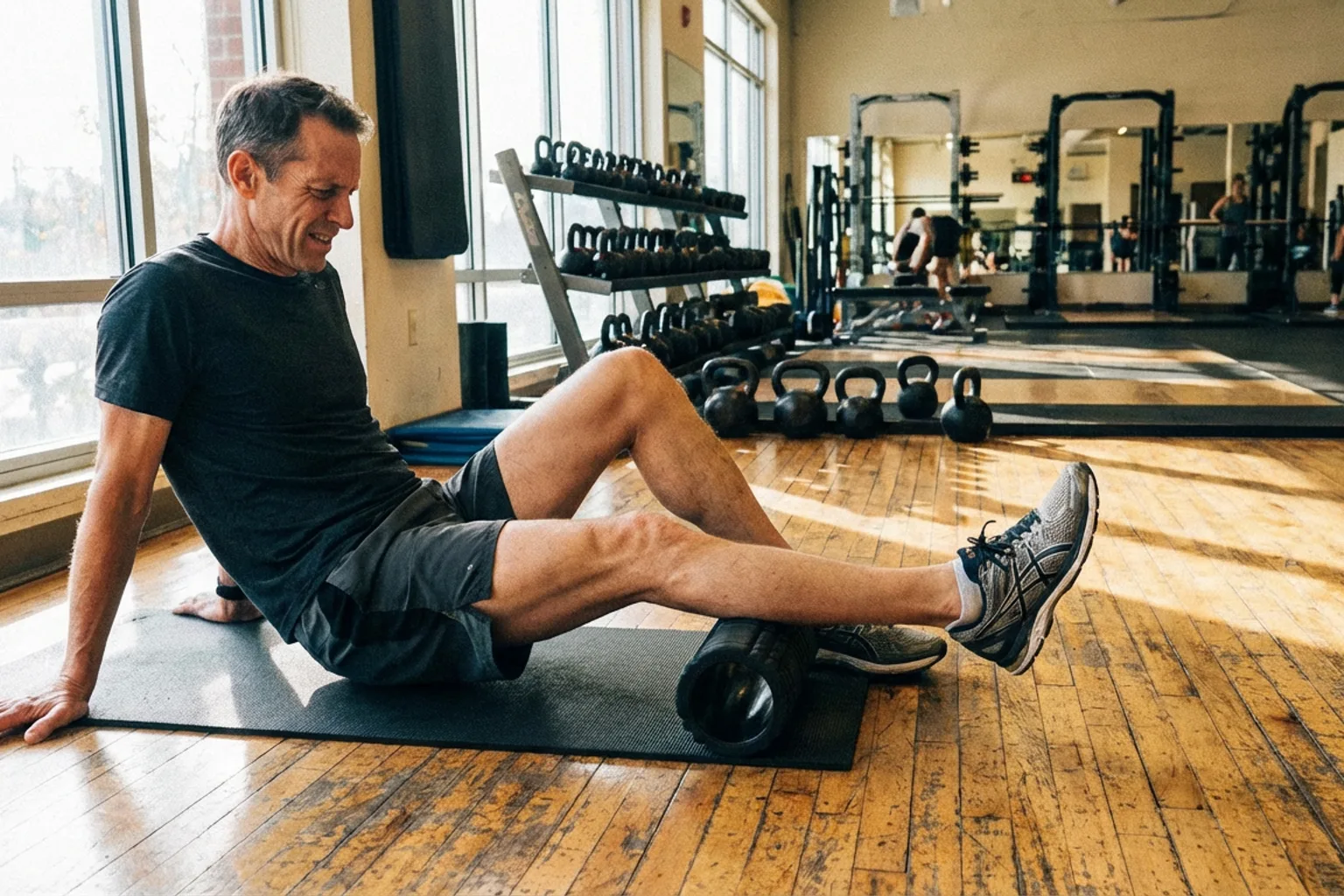
foam rolling and Self-Massage
Spend 5-10 minutes rolling key areas after runs. Focus on:
- Calves: roll slowly, pausing on tight spots
- IT band and TFL: roll the outer thigh
- Glutes and piriformis: use a firm ball for deeper tissue
- Thoracic spine: roll your upper back to improve posture
Here's a guide to self-massage for tight calf muscles that's particularly useful for masters runners prone to Achilles and plantar fascia issues.
Step 7: Address Hormonal Changes Directly
This is a topic most running guides skip entirely. But it matters enormously for runners over 40.
For Men
Testosterone declines gradually from around age 30, dropping roughly 1-2% per year. Lower testosterone means slower muscle protein synthesis, reduced bone density, and longer recovery times. You can't stop this process, but you can slow it significantly.
What helps:
- Strength training (particularly compound lifts) stimulates testosterone production
- Adequate sleep: testosterone is produced during deep sleep
- Maintaining a healthy body weight: excess body fat converts testosterone to oestrogen
- Limiting alcohol: even moderate drinking suppresses testosterone
- Managing chronic stress: high cortisol directly suppresses testosterone
For Women
Perimenopause and menopause bring significant changes that directly affect injury risk. Declining oestrogen reduces collagen synthesis, making tendons and ligaments more vulnerable. Bone density decreases, raising the risk of stress fractures. Energy levels and recovery capacity fluctuate with hormonal cycles.
Practical adjustments:
- Prioritise weight-bearing strength training to protect bone density
- Increase protein intake: oestrogen decline reduces muscle protein synthesis efficiency
- Track your cycle if you're still menstruating and adjust training intensity accordingly
- Discuss HRT with your GP if symptoms are significantly affecting your training and recovery
- Ensure adequate calcium (1000-1200mg/day) and vitamin D (at least 800-1000 IU/day)
Step 8: Know When to Stop and Seek Help
This is where many masters runners go wrong. The mental toughness that makes you a good runner can work against you when you're injured. Research shows that 69% of masters athletes try to push through pain to maintain their training. Most of the time, this turns a two-week problem into a two-month one.
Here's a simple decision framework.
Green Light: Manage It Yourself
- Mild muscle soreness that appears 24-48 hours after a hard session
- General fatigue that improves with a rest day
- Minor tightness that eases within the first 10 minutes of a run
Amber Light: Reduce Load and Monitor Closely
- Pain that starts during a run but doesn't worsen as you continue
- Discomfort rated 3-4 out of 10 that disappears within an hour of finishing
- Stiffness that takes more than 10 minutes to ease at the start of a run
At this stage: cut mileage by 30-50%, avoid hills and speed work, add the relevant strength exercises from Step 3, and monitor over 5-7 days.
Red Light: Stop Running and Get Assessed
- Sharp, localised pain that worsens during a run
- Pain rated above 5 out of 10 during running
- Pain that causes you to alter your gait or limp
- Swelling, bruising, or significant warmth around a joint
- Bone pain that worsens progressively through a run
- Any pain that persists for more than 2 weeks despite reduced training
Stop. Rest. See a sports physiotherapist or sports medicine doctor. The sooner you get a proper diagnosis, the sooner you can start a targeted rehab programme.
Once you're cleared to return, read this guide on successfully returning from a running injury to make sure you get it right the first time.
Step 9: Return to Running After Injury
Coming back too fast is the single most common reason masters runners re-injure themselves. I see it constantly. Someone has four weeks off, feels great, runs their old route at their old pace, and is back on the physio table within a fortnight.
Here's a structured return-to-running protocol for masters runners.
Phase 1: Walk-Run Intervals (Week 1-2)
Start only when you can walk for 30 minutes without pain.
- Day 1: 1 min run / 2 min walk x 8 rounds
- Day 3: 1 min run / 2 min walk x 10 rounds
- Day 5: 2 min run / 2 min walk x 8 rounds
- Day 7: 2 min run / 1 min walk x 10 rounds
If any session causes pain above 3 out of 10, go back one step.
Phase 2: Continuous Easy Running (Week 3-4)
- Day 1: 15 minutes continuous easy running
- Day 3: 20 minutes continuous easy running
- Day 5: 25 minutes continuous easy running
- Day 7: 30 minutes continuous easy running
Phase 3: Gradual Mileage Build (Week 5 onwards)
Now apply the 10% rule (or less). Add no more than 10% to your total weekly mileage every two weeks. Don't reintroduce speed work or hills until you've completed at least four weeks of pain-free continuous running.
The full return to running after injury guide walks you through this in more detail with specific progressions for different injury types.
Movement Quality: The Missing Link Most Runners Ignore
Here's a gap I see in most injury prevention advice for masters runners. Everyone talks about strength and mileage. Very few people talk about movement quality.
Movement quality means how well you move through the fundamental patterns your body needs for running: hip extension, hip flexion, ankle dorsiflexion, thoracic rotation, and single-leg stability.
After 40, restrictions in any of these areas force compensations elsewhere. A stiff ankle makes your knee work harder. A restricted hip makes your lower back compensate. These compensations accumulate over thousands of running steps and eventually cause injury.
The Masters Runner Mobility Checklist
Test yourself on these movements. If any feel restricted or painful, they need attention.
- Ankle dorsiflexion: Can you lunge your knee 10cm past your toes without your heel lifting? If not, your calves and ankle mobility need work.
- Hip extension: In a kneeling lunge, can you feel a comfortable stretch in your front hip? Tight hip flexors pull your pelvis forward and increase lower back load.
- Single-leg balance: Can you stand on one leg for 30 seconds with your eyes closed? If not, your proprioception and ankle stability need work.
- Thoracic rotation: Sit cross-legged and rotate your upper body. Can you reach 45 degrees each way without your lower back moving? Stiff thoracic spine forces your lower back to rotate instead.
- Hip abduction strength: In a side-lying position, can you lift your top leg to 45 degrees without your pelvis rolling back? Weakness here contributes to IT band syndrome and hip drop.
For runners with hip issues, this guide on running with femoral acetabular impingement covers the hip mobility work in detail.
Cross-Training: Your Injury Insurance Policy
One of the smartest things a masters runner can do is build cross-training into their weekly schedule, not just when injured, but as a regular part of their programme.
Cross-training maintains cardiovascular fitness, reduces the total impact load on your joints, and gives your tendons and bones recovery time while you stay fit.
The best options for masters runners:
- Cycling: Excellent cardiovascular stimulus with zero impact. Great for active recovery days.
- Swimming: Full-body conditioning with no joint impact. Particularly good during injury.
- Aqua jogging: Maintains running-specific fitness without impact. Read the aqua running guide to see how to use it beyond just injury management.
- Rowing: Builds posterior chain strength alongside cardiovascular fitness.
- Yoga or Pilates: Improves mobility, core control, and body awareness. All three are valuable for masters runners.
Footwear: What Actually Matters After 40
I'm going to be direct here. The relationship between running shoes and injury is more complicated than the running shoe industry would like you to believe. There's no strong evidence that any specific shoe type prevents injury universally.
What does matter:
- Fit: Your shoe should have a thumb's width of space between your longest toe and the end of the shoe. Your heel should sit securely without slipping.
- Cushioning: After 40, many runners benefit from more cushioning, particularly for longer runs. But "more cushioning" doesn't mean "better for everyone." Some runners do better in firmer shoes.
- Stack height changes: If you're considering switching to a lower-drop or minimalist shoe, do it very gradually. Your Achilles and plantar fascia need months to adapt. Rushing this transition is a very common cause of injury in masters runners.
- Rotation: Running in two or three different pairs of shoes, rotating them across sessions, reduces repetitive stress on the same tissues. Research supports this approach for injury prevention.
- Replacement: Replace your shoes every 500-800 kilometres. The midsole cushioning degrades well before the upper shows obvious wear.
If you're unsure about your foot mechanics, this running foot health self-assessment is a good starting point before visiting a specialist.
Frequently Asked Questions
What are the most common running injuries over 40?
The most common running injuries over 40 are Achilles tendinopathy, plantar fasciitis, patellofemoral pain (runner's knee), IT band syndrome, hamstring tendinopathy, and calf strains. Masters runners are more prone to soft-tissue injuries in the lower leg compared to younger runners, who tend to get more bone stress injuries and knee pain.
How many days a week should a runner over 40 train?
Most masters runners do well with 3-4 running days per week, plus 2 strength sessions and 1-2 active recovery or cross-training days. The key shift after 40 is treating recovery days as training, not wasted time. Running 5-6 days per week without adequate recovery is a primary driver of injury in this age group.
Should I stretch before or after running when I'm over 40?
Do dynamic stretching and movement preparation before running, not static stretching. Save static stretching for after your run. Static stretching a cold muscle before exercise can actually reduce power output and increase injury risk. After running, hold static stretches for 30-45 seconds to improve flexibility when your muscles are warm.
How long does it take to recover from a running injury after 40?
Recovery from running injuries takes longer after 40 than it did in your 20s and 30s. A mild soft-tissue injury that might take 2-3 weeks to resolve in a younger runner can take 4-8 weeks in a masters runner. Tendon injuries like Achilles tendinopathy can take 3-6 months to fully resolve with proper loading and rehab.
Can I keep running with a minor injury if I'm over 40?
It depends on the injury. Mild muscle soreness and minor tightness that eases within the first 10 minutes of a run can often be managed with reduced mileage and targeted strengthening. But sharp, localised pain, pain above 3-4 out of 10, or pain that worsens during a run is a signal to stop and get assessed. Pushing through warning signs is the most common mistake masters runners make.
The Bottom Line
Running injuries over 40 are not inevitable. They're largely predictable and preventable when you understand what's changed in your body and adapt your approach accordingly.
The runners I work with who stay healthy year after year share a few common habits: they train mostly easy, they strength train consistently, they warm up properly, they sleep enough, and they act on warning signs early rather than hoping things will sort themselves out.
Start with Step 1. Identify exactly what you're dealing with. Then work through the steps systematically. You don't need to overhaul everything at once. Even making two or three of these changes will meaningfully reduce your injury risk.
You've got plenty of good running ahead of you. Let's make sure you stay healthy enough to enjoy it.