Strength Training for Runners Short on Time
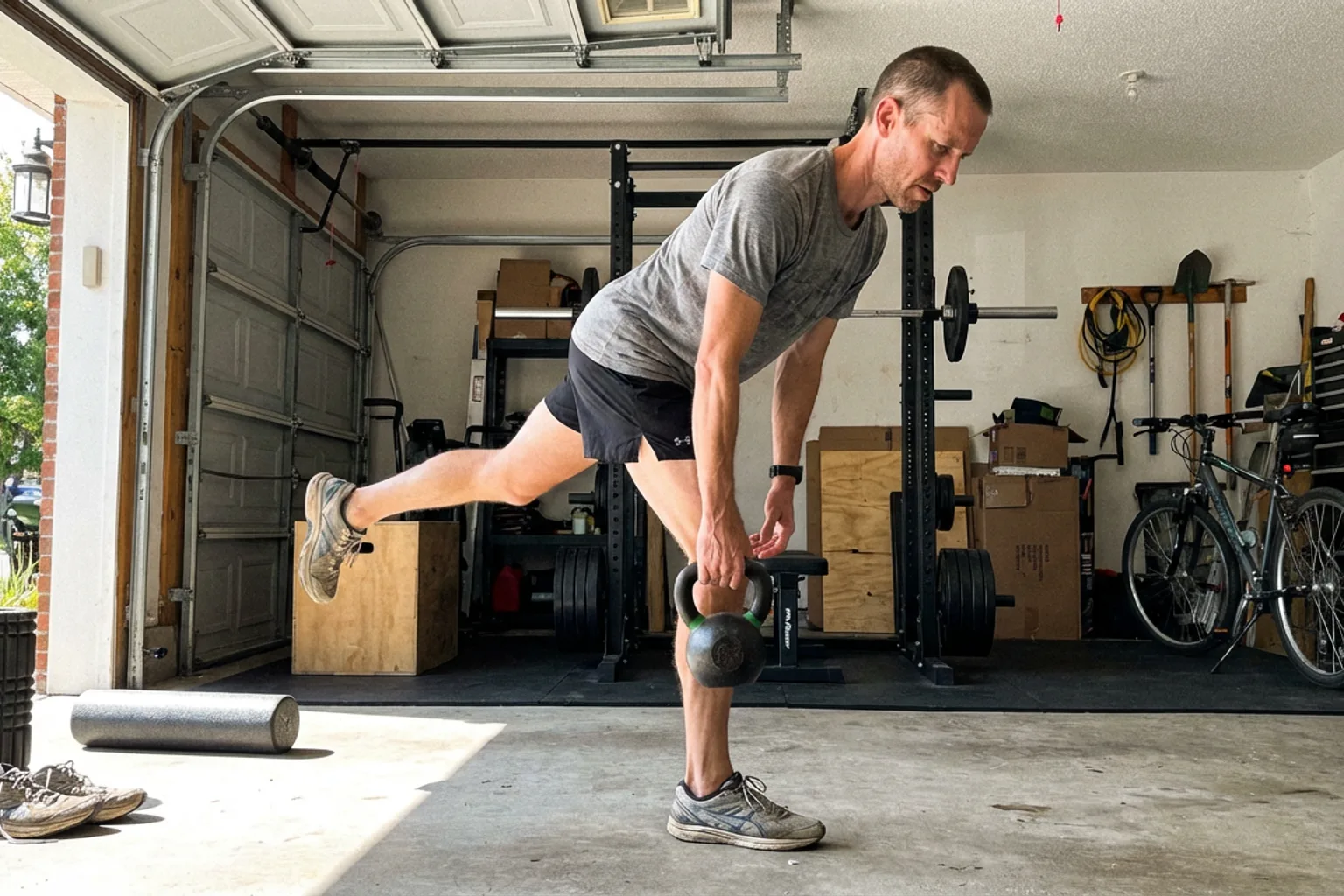
If you're like most runners I coach, strength training for runners short on time isn't just a nice idea, it's the only way it actually happens. Life gets busy. Training logs fill up. And the gym session is always the first thing to get dropped when something has to give.
I get it. I've been there myself. But here's what I've learned after two decades of coaching runners: a focused 20-minute strength session twice a week will do more for your running than you think possible.
The research backs this up. A study in the British Journal of Sports Medicine found that strength training reduces sports injuries by nearly 70%. Separate research shows that just eight weeks of strength work can improve running economy by around 5% in well-trained runners. That means you use less energy at the same pace. Free speed, essentially.
So this article is for you if you have 20 minutes, a pair of dumbbells (or just your bodyweight), and the desire to run stronger and stay injury-free. I've stripped this down to the nine most effective moves for runners, ordered from most impactful to most targeted. Do them all in one session, or split them across two shorter sessions in your week.
Quick Answer: The best strength training for runners short on time focuses on single-leg exercises, hip and glute work, and posterior chain loading. Two sessions of 20 minutes per week, covering the 9 exercises below, is enough to improve performance and cut injury risk significantly.
Why Runners Short on Time Need to Prioritise Strength Work
Before we get into the exercises, I want to make one thing clear. Strength training isn't just an add-on for runners. It's a core part of the programme.
Every time your foot hits the ground, your body absorbs two to three times your bodyweight in force. Your muscles, tendons, and joints have to handle that load thousands of times per run. If those structures aren't strong enough, something eventually breaks down.
I've seen this pattern repeat with runners at every level. They train hard, mileage climbs, and then a niggle appears, usually in the knee, hip, or calf, that could have been prevented with consistent strength and mobility work. The good news? You don't need hours in the gym to fix this.
Here's the thing: quality beats quantity every time with runner strength training. Two focused sessions per week, targeting the right muscles in the right way, will outperform four random gym sessions every time.
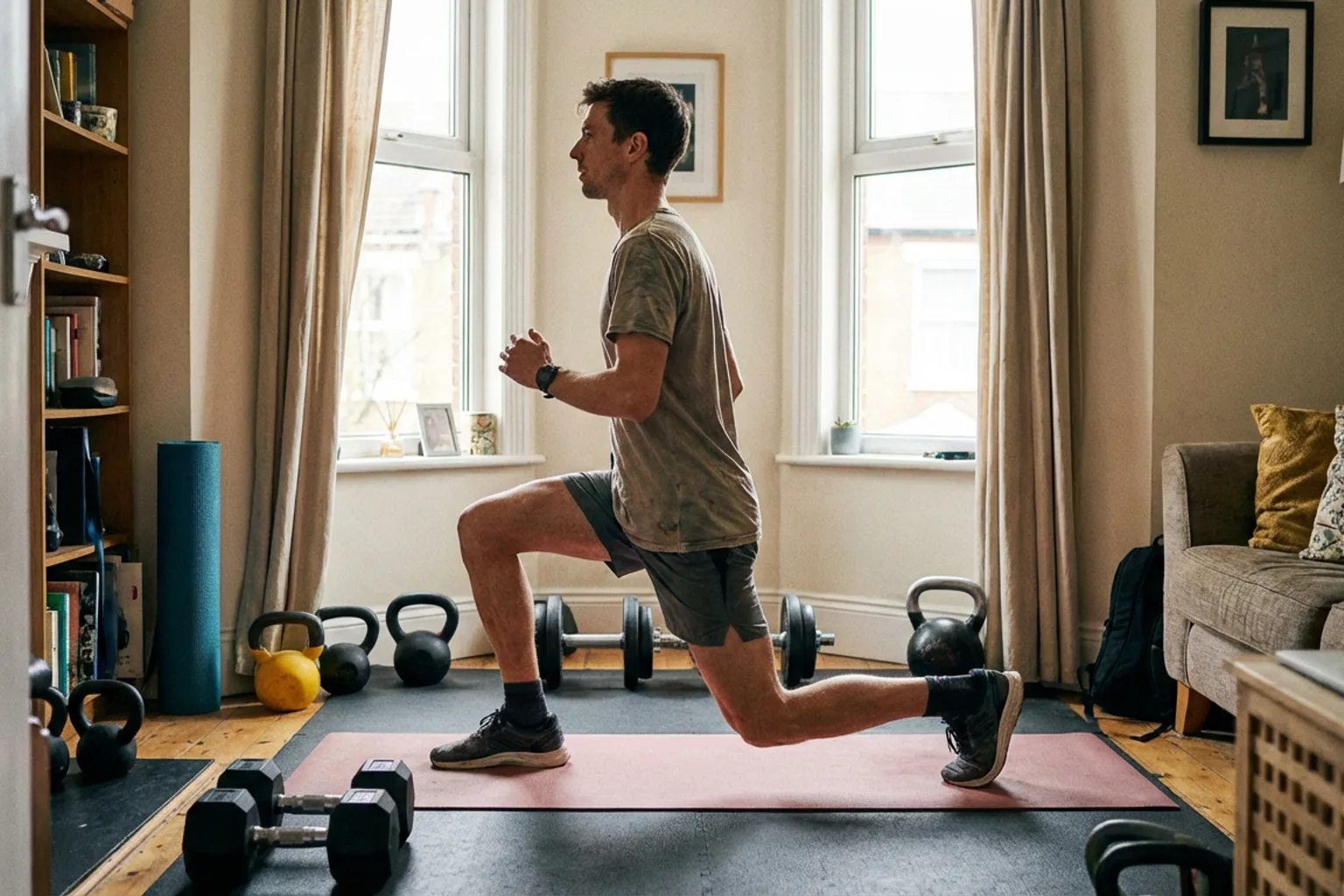
How to Structure Your 20-Minute Strength Session
Keep it simple. Here's the format I use with my runners:
- Warm-up: 3 to 5 minutes of glute activation exercises and dynamic movement
- Main work: 3 sets of each exercise, 8 to 12 reps per side where applicable
- Rest: 30 to 45 seconds between sets, minimal rest between exercises
- Frequency: Twice per week, ideally not on your hardest run days
You won't complete all nine exercises in one session when you're starting out. That's fine. Pick five or six, rotate them, and build up over time. The bodyweight workout approach works brilliantly here, no equipment needed for most of these.
Strength Training for Runners Short on Time: The 9 Best Exercises
1. Split Squat: The Single Best Exercise for Runners
If you only do one exercise from this list, make it the split squat. I've recommended this move to hundreds of runners over the years, and the results speak for themselves.
Running is a single-leg sport. Every stride, you're balancing on one leg while generating force through the hip, knee, and ankle simultaneously. The split squat trains exactly that pattern. It builds quad, glute, and hamstring strength in a position that mirrors the demands of running.
Research shows strength training improved running economy and time to exhaustion by over 20%, with increased stride length as a key factor. Split squats directly drive that adaptation.
How to do it:
- Stand in a staggered stance, front foot flat, rear foot up on a step or bench for the harder Bulgarian variation
- Lower your back knee toward the floor, keeping your front shin as vertical as possible
- Drive through your front heel to return to the start
- Complete 8 to 10 reps per side, adding dumbbells as you get stronger
Check out my full breakdown of split squats for running if you want to progress this properly. And if you're ready for the advanced version, the Bulgarian split squat is a serious challenge worth working toward.
2. Single-Leg Romanian Deadlift: Posterior Chain Power
This exercise builds the hamstrings, glutes, and lower back in one movement, exactly the muscles that propel you forward on every stride.
Most runners are quad-dominant. They push well but don't pull well. The single-leg Romanian deadlift fixes that imbalance by loading the posterior chain through a hip hinge on one leg. It also challenges your balance, which is a huge bonus for trail runners and anyone running on uneven ground.
How to do it:
- Stand on one leg with a soft bend in the knee
- Hinge forward at the hip, reaching your opposite hand toward the floor while your free leg extends behind you
- Keep your back flat and hips square throughout
- Drive through your standing heel to return upright
- Complete 8 to 10 reps per side
I've written a detailed guide on the single-leg deadlift for glute training that covers common technique errors. Worth a read before you load this one up.
3. Bulgarian Split Squat: Advanced Leg Strength
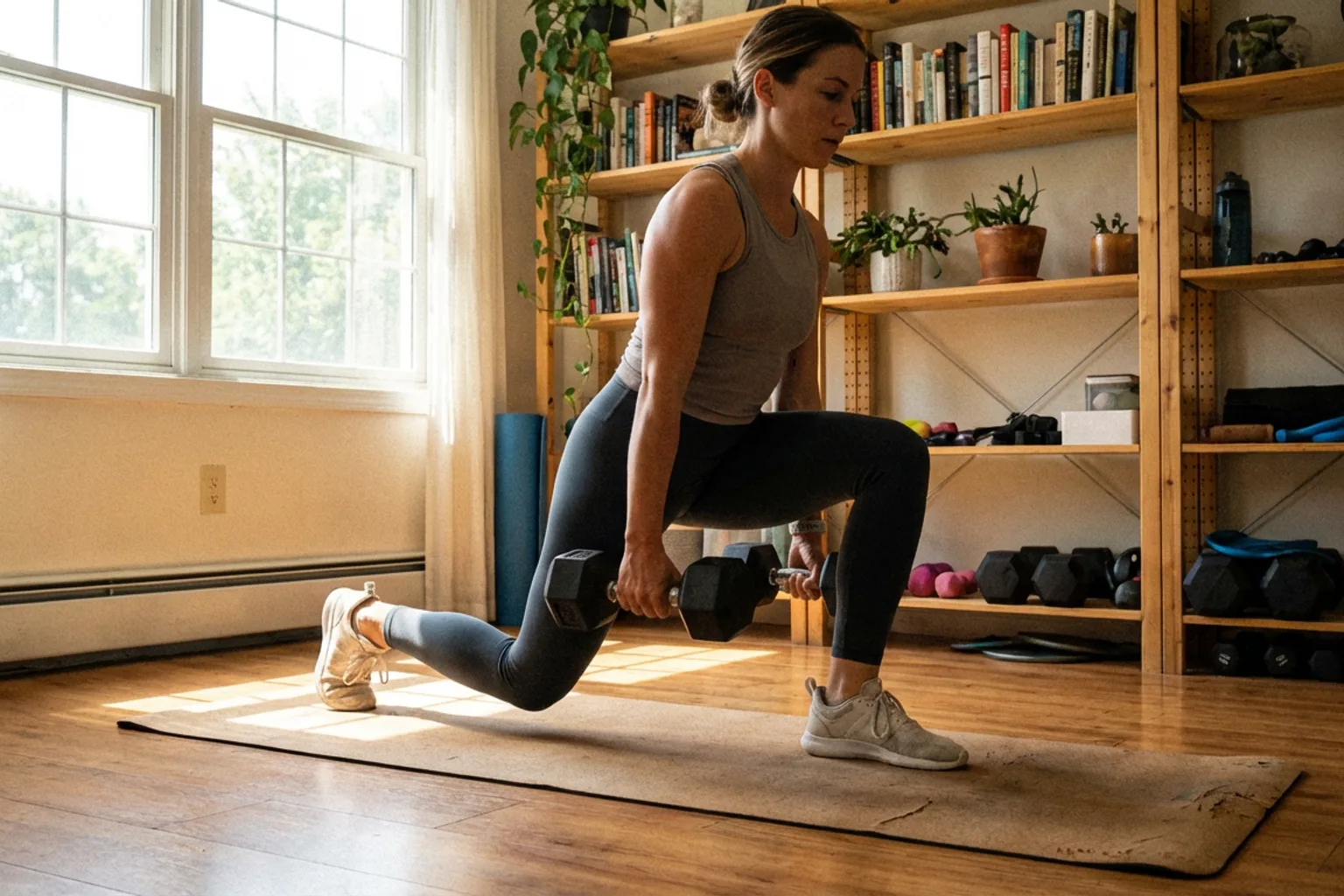
The Bulgarian split squat is the most demanding single-leg exercise in this list, and for good reason. Elevating the rear foot increases the range of motion and shifts more load onto the front leg, making it a serious strength builder for the quads and glutes.
I typically introduce this to runners after they've mastered the standard split squat. It's particularly effective for runners training for hilly courses, where quad strength under load is critical.
How to do it:
- Place your rear foot on a bench or step behind you, laces down
- Lower your back knee toward the floor, keeping your torso upright
- Your front knee should track over your second toe, not caving inward
- Press through your front heel to drive back up
- Aim for 6 to 8 reps per side with added weight once bodyweight feels manageable
If you're training for a hilly race, I'd strongly recommend reading my guide on strength training for hilly marathon success alongside this.
4. Calf Raise (Bent Knee and Straight Knee): Power Your Propulsion
Your calves take an enormous beating during running, yet most runners never train them directly. The calf complex, gastrocnemius and soleus, generates the propulsive force that drives you forward at toe-off. Weak calves are one of the most common contributors to Achilles tendon problems and plantar fasciitis.
Here's the key detail most people miss: you need to train both the gastrocnemius (straight-leg calf raise) and the soleus (bent-knee calf raise) separately. The soleus in particular is hugely important for distance runners, as it's the primary load-bearer during slow, sustained running.
How to do it:
- Stand on the edge of a step with your heel hanging off
- Lower your heel slowly, take 3 seconds on the way down
- Rise up onto your toes and hold briefly at the top
- For the straight-leg version, keep your knee extended throughout
- For the bent-knee version, maintain a 30-degree bend in the knee to target the soleus
- Complete 15 reps per leg of each variation
The slow eccentric (lowering) phase is the key. That's where the tendon adaptation happens. My soleus strength guide goes deep on this if you want the full picture.
5. Single-Leg Bridge: Glute Strength Without the Gym
The single-leg bridge is one of the most underrated exercises for runners, and you can do it anywhere with no equipment at all.
Weak glutes are at the root of so many running injuries, IT band syndrome, patellofemoral pain, and hip flexor strains all trace back to insufficient glute strength and activation. The single-leg bridge isolates the glute max and challenges hip stability in a way that's safe even for injured runners.
How to do it:
- Lie on your back with knees bent, feet flat on the floor
- Lift one foot off the floor and extend that leg
- Drive through the heel of your planted foot to lift your hips toward the ceiling
- Squeeze your glute at the top and hold for 2 seconds
- Lower slowly and repeat for 10 to 12 reps per side
Once this feels easy, add a resistance band above the knees or try the single-leg bridge progressions I've outlined elsewhere on the site.
6. Side Plank with Hip Abduction: Lateral Hip Stability
This exercise targets the glute medius, the muscle most responsible for keeping your pelvis level when you run.
Watch a runner with weak glute medius. Their pelvis drops on one side with every stride, what we call a Trendelenburg gait. That pelvic drop creates a chain reaction of stress through the IT band, knee, and lower back. One simple exercise done consistently can prevent all of that.
How to do it:
- Get into a side plank position, either on your knee (easier) or your foot (harder)
- Keep your hips stacked and your body in a straight line
- Lift your top leg 20 to 30 centimetres, hold for 2 seconds, then lower
- Complete 10 reps per side
- Progress by adding a resistance band above the knees
The side plank for core strength and the glute medius exercise guide on this site both cover this in more detail, including common mistakes to avoid.
7. Eccentric Step Down: Protect Your Knees on Descents
This exercise is the single best thing you can do for patellofemoral pain and knee resilience during downhill running.
The eccentric step down trains your quad to control deceleration, the exact demand placed on the knee when running downhill or during the landing phase of every stride. It's also a brilliant test of knee stability. If your knee wobbles inward during the movement, you've found a weakness worth addressing.
How to do it:
- Stand on a step or low box on one leg
- Slowly lower your other foot toward the floor by bending your standing knee
- Take 3 to 4 seconds to lower, the slow descent is the whole point
- Tap the floor lightly, then drive back up through your standing leg
- Keep your standing knee tracking over your second toe throughout
- Complete 8 to 10 reps per side
If you're training on hilly terrain, pair this with my downhill running strength guide for a complete approach.
8. Push-Up: Upper Body and Core in One
Runners often neglect upper body strength, but your arm swing directly influences your running cadence and form.
A powerful, efficient arm swing helps maintain rhythm and prevent the upper body collapse you see in tired runners late in a race. Push-ups also build the chest, shoulder, and tricep strength that supports your posture over long distances. And because they demand full-body tension, they train your core at the same time.
How to do it:
- Set up with hands slightly wider than shoulder-width, body in a straight line from head to heels
- Keep your glutes and core braced throughout, don't let your hips sag
- Lower your chest to the floor under control, then press back up
- Aim for 10 to 20 reps depending on your level
- Elevate your feet to make it harder, or drop to your knees to make it easier
If you want to add a rotational element that better mimics running demands, try the push-up with a T-rotation, press up, then rotate your body and reach one arm to the ceiling. That's a full upper body and core challenge in one move.
9. Pallof Press: Rotational Core Stability
The Pallof press trains your core to resist rotation, exactly what it needs to do during every running stride.
Most core exercises train flexion (crunches, sit-ups) or extension (back extensions). But running demands rotational stability. Your core has to prevent your trunk from twisting excessively with each arm swing and leg drive. The Pallof press targets this anti-rotation function directly.
You can do this with a resistance band anchored to a fixed point, or with a cable machine at the gym.
How to do it:
- Anchor a resistance band at chest height to a post, door frame, or cable machine
- Stand side-on to the anchor point, feet shoulder-width apart
- Hold the band at your chest with both hands
- Press the band straight out in front of you, hold for 2 seconds, then return
- The band will try to rotate you toward the anchor, resist that pull
- Complete 10 reps per side
Pair this with the 10-minute core workout for runners on days when you want to focus purely on core strength.
How to Fit These Exercises Into Your Training Week
Here's the question I get asked most: when do I actually fit this in?
The honest answer is that it depends on your weekly mileage and recovery capacity. But here's a simple framework that works for most runners:
| Day | Running | Strength |
|---|---|---|
| Monday | Easy run or rest | Session A: Exercises 1, 2, 4, 6, 9 |
| Tuesday | Quality run (tempo or intervals) | None |
| Wednesday | Easy run | None |
| Thursday | Easy run | Session B: Exercises 3, 5, 7, 8, 4 |
| Friday | Rest or cross-training | None |
| Saturday | Long run | None |
| Sunday | Rest or easy run | None |
Notice I've placed strength sessions on easy run days, not before or after hard run sessions. That's deliberate. You want to arrive at your quality sessions fresh, and you want to recover from strength work without it compromising your running the next day.
If even that feels like too much, start with one session per week. Consistency over time beats perfection in the short term every time.
The Most Common Mistakes Runners Make With Strength Training
I've coached enough runners to know the pitfalls. Here are the ones I see most often:
- Going too heavy too soon. Technique breaks down, injury risk goes up. Start lighter than you think you need to and nail the movement first.
- Skipping single-leg exercises. Bilateral squats and deadlifts are fine, but running is single-leg. Train single-leg to get the most specific adaptation.
- Neglecting the posterior chain. Quads get all the attention. But your glutes, hamstrings, and calves do the real work in running. Prioritise them.
- Stopping when training ramps up. This is the big one. Runners drop strength work exactly when they need it most, during peak training blocks. Even one session per week maintains the gains you've built.
- Not progressing the load. If you've been doing 10 bodyweight split squats for six months and it still feels easy, you're not getting stronger. Add weight, slow the tempo, or increase reps to keep adapting.
For a deeper look at how to balance your training, my article on how often runners should do strength and mobility work covers this in detail.
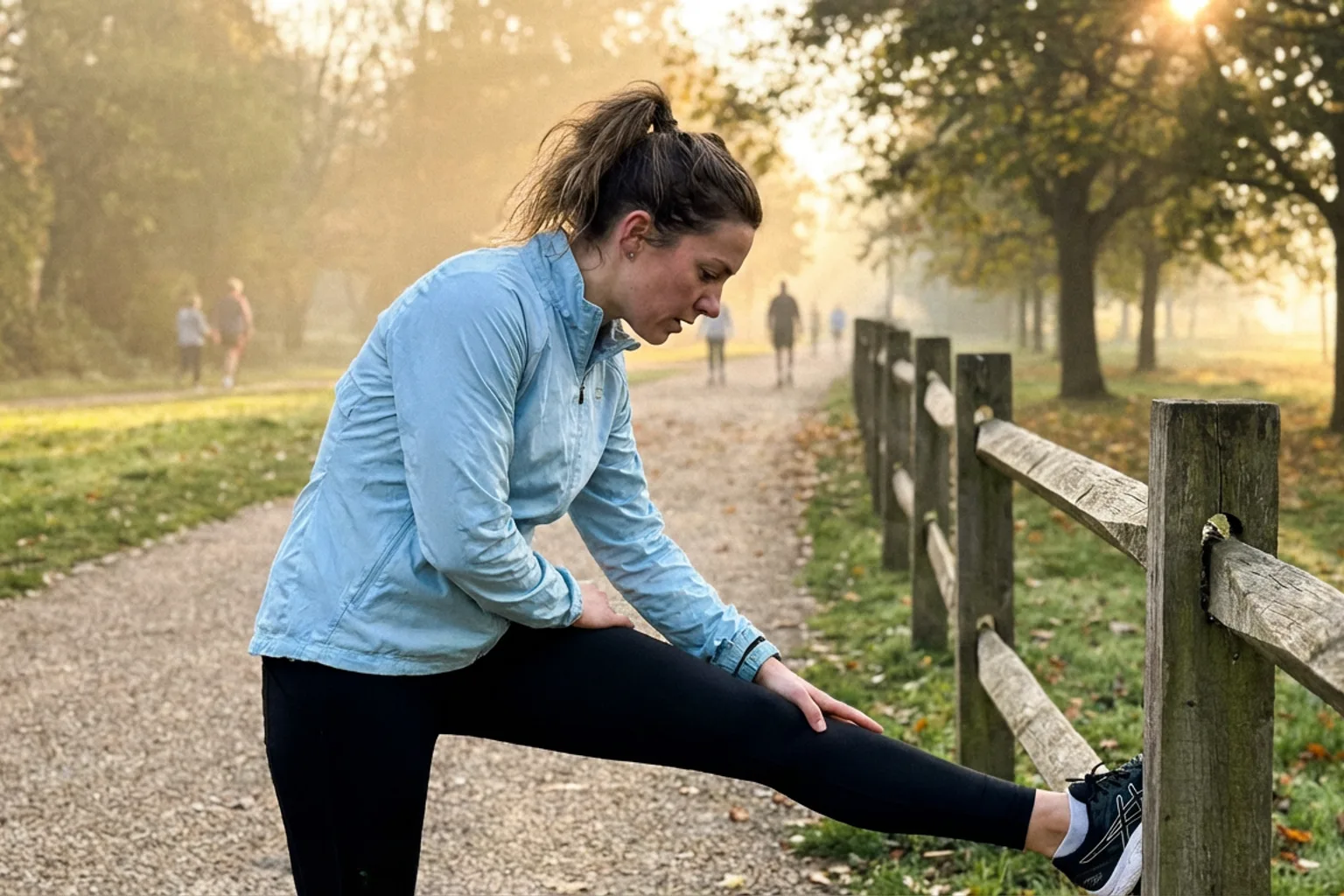
Do You Need Equipment?
No. Most of these exercises work perfectly with bodyweight alone, especially when you're starting out. As you get stronger, a pair of adjustable dumbbells is the single best investment you can make. They let you progress the split squat, Romanian deadlift, and Bulgarian split squat significantly.
A resistance band is the other useful tool. It adds load to the side plank abduction, Pallof press, and calf raise variations without taking up much space or costing much money. My resistance band routine for runners shows you exactly how to use one effectively.
You don't need a gym membership. You don't need a full rack of weights. You need consistency and the right exercises, and you've got both now.
Frequently Asked Questions
How often should runners do strength training?
Twice per week is the sweet spot for most runners. Research supports two sessions per week as sufficient to build meaningful strength and reduce injury risk. One session per week can maintain gains during heavy training blocks. Avoid strength training the day before your hardest run sessions to protect performance and recovery.
Can I do strength training on the same day as running?
Yes, but order matters. Run first, then strength train, especially if your run involves quality work like intervals or tempo. Doing strength work before a quality run compromises your speed and form. On easy run days, the order matters less, though most runners find it easier to do strength work after the run.
How long before I see results from strength training as a runner?
Most runners notice improved stability and reduced niggles within four to six weeks of consistent twice-weekly strength work. Running economy improvements typically show up after eight to twelve weeks. Strength gains themselves are measurable within four weeks, even before visible muscle changes occur.
Should runners lift heavy or do high reps?
Both have a place. For injury prevention and running economy, moderate loads with controlled tempo work well, think 3 sets of 8 to 12 reps. For maximal strength and power development, lower reps with heavier loads are more effective. Most time-crunched runners get the best return from moderate loads with slow eccentric tempos, which maximises tendon adaptation.
What if I'm already injured? Can I still do these exercises?
Some of these exercises are appropriate for injured runners and some are not, depending on the injury. The single-leg bridge and Pallof press are generally safe for most common running injuries. The step-down and split squat may need to be modified or avoided depending on your knee or hip issue. Always check with a physio before loading an injured structure.
The Bottom Line
Strength training for runners short on time doesn't have to be complicated. These nine exercises cover the key movement patterns that matter most for running performance and injury prevention. Two sessions of 20 minutes per week, done consistently over months, will make you a stronger, more resilient runner.
Pick your five favourites from this list and start this week. Don't wait for the perfect programme or the perfect time. The best strength session is the one you actually do.
If you want to go deeper on strength training for distance runners, or explore multiplanar strength exercises that take your training to the next level, those resources are waiting for you. But start here, start simple, and start now.